Bruno Mars Toronto Postponement Exposed a Critical Ticketing Gap
When the Show Doesn't Go On: MultiX Innovations Addresses the Hidden Cost of Ticket Uncertainty in a New Regulatory Era
Blockchain infrastructure company MultiX Innovations points to the unresolved gap between consumer protection policy and real-world ticket lifecycle management — and the artists left behind when tickets change hands.
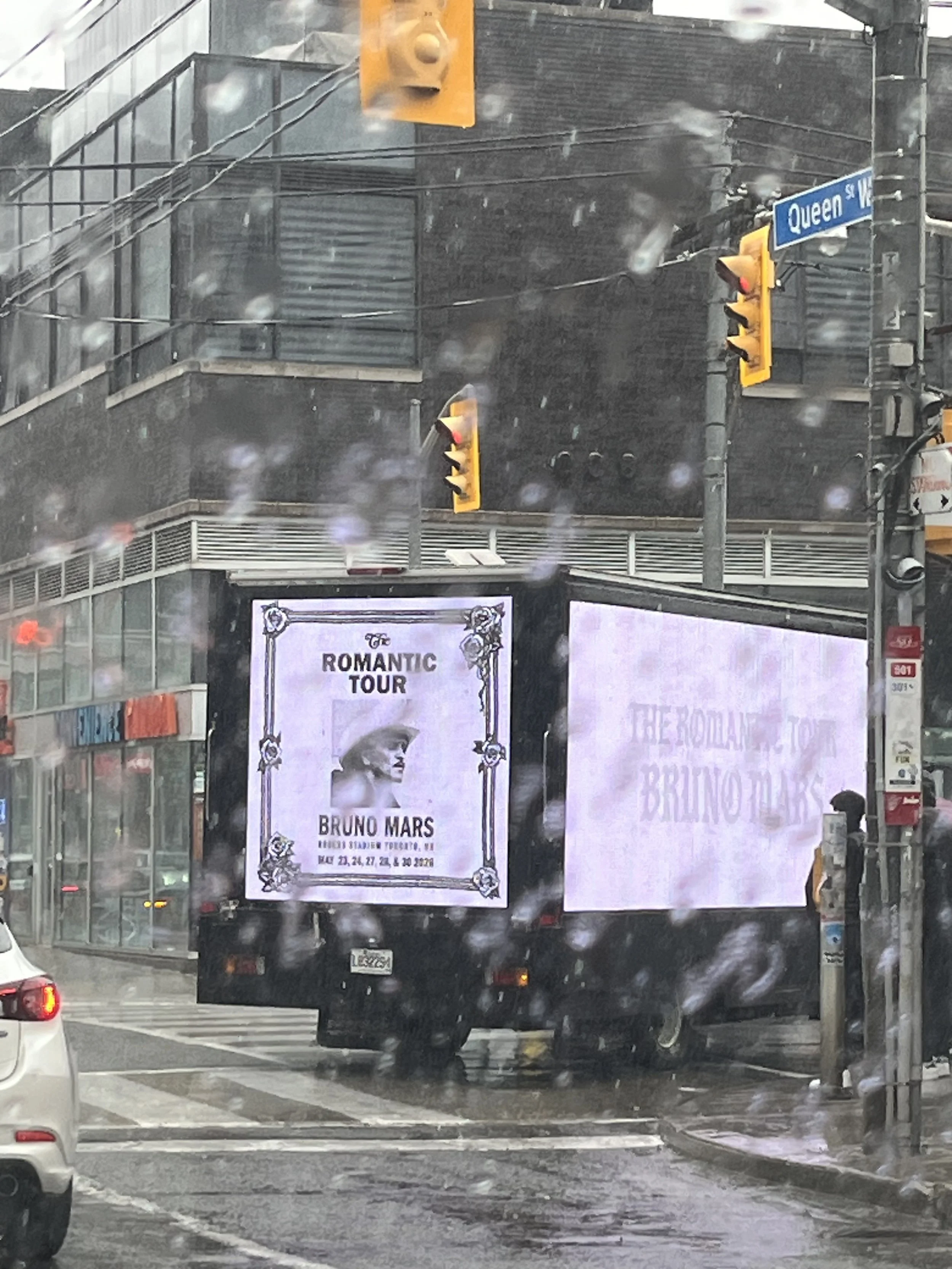
The Bruno Mars Romantic Tour billboard truck on Queen Street West, Toronto — May 23, 2026, the day the show was cancelled due to severe weather. Tens of thousands of ticketholders received last-minute notification through social media and third-party platforms with no direct information from the event organizer.
Last weekend, tens of thousands of Toronto fans experienced firsthand what the live events industry already knows: a ticket is not just a purchase. It's a promise — one that can be disrupted by weather, logistics, and circumstances beyond anyone's control. When that promise is broken, even temporarily, the downstream questions multiply fast. What happens to the ticket? Can it be transferred? Is it still valid? Who holds the record? And critically — how do you reach every single ticketholder at once, with verified information, in real time?
These are not new questions. But in the span of a few weeks, two high-profile cancellations on two continents have made them impossible to ignore.
In late April, fans travelling to Vienna's Gasometer were met with a last-minute cancellation of a highly anticipated Christopher Cross concert. Weeks later, the same scene played out in Toronto — a Bruno Mars Romantic Tour billboard truck navigating rain-soaked Queen Street West on the very afternoon his Rogers Stadium show was called off. Even the billboard truck displayed outdated information about the show that evening. The image captures something the industry has long avoided confronting: the infrastructure behind a modern concert ticket was not built for this moment.
Ontario's recently enacted amendments to the Ticket Sales Act represent a meaningful step toward consumer fairness in the live events market. MultiX Innovations Ltd. supports that legislation — protecting fans from exploitation and ensuring access to live events remains within reach for ordinary Ontarians. As blockchain infrastructure builders, we understand what fair, transparent ticketing requires at the infrastructure level.
The gap we see is not one of intent. It is one of architecture.
Price transparency is only one layer of the problem. A ticket can be fairly priced and still be fraudulent. It can comply with resale caps and still be untraceable. It can be transferred and still leave both buyer and seller without verified proof of the transaction. When an event is postponed or cancelled, the chain of custody for every affected ticket becomes a critical question — one that existing infrastructure was not built to answer cleanly.
When tens of thousands of ticketholders need to be reached simultaneously — with verified, authoritative information about a cancellation, a reschedule, a refund — the current system relies on third-party platforms, email lists, and social media. There is no direct, verified channel from event organizer to ticketholder. There is no on-chain record of who holds what ticket, in what form, at the moment the decision is made. The result: confusion, fraud risk, and fans left scrambling.
MultiX Innovations builds the infrastructure layer that makes those answers possible. Our blockchain-based ticket minting platform creates an immutable, verifiable record of every ticket from the moment it is issued to the moment it is used. Every transfer, every resale, every cancellation and reissue is recorded on-chain. Revenue flows are transparent. Smart contracts enforce the rules automatically. And when something goes wrong — when the weather turns, when the show is postponed — every current ticketholder can be identified and reached through a single, verified source of truth.
There is another layer the current legislation does not yet reach: the artist.
The founding conviction behind MultiX grew from a simple observation — one that Grammy and Oscar-winning artist Christopher Cross voiced publicly: that artists, the very reason tickets exist, are among the last to benefit when those tickets change hands. When a ticket is resold on the secondary market, the artist who filled that seat sees nothing. MultiX's smart contract infrastructure changes that. Programmable royalty logic means that every secondary transaction automatically returns a defined percentage to the rights holder — transparently, instantly, and without negotiation. Fan pays. Artist earns. Every time.
This is not an abstract promise. It is what blockchain infrastructure was built to do — and what MultiX is already engineering into the foundation of the ticketing lifecycle.
For ticket sellers, venues, and platforms operating in Ontario's new regulatory environment, this is not a luxury. It is the foundation that makes compliance provable, disputes resolvable, and fan trust earnable.
MultiX is not a ticketing platform. We are the infrastructure that ticketing platforms are built on.
We work with sellers, promoters, organizers and platforms to bring the full ticket lifecycle — minting, assignment, activation, post-event — onto a transparent, auditable chain. In a market where the rules are changing and the stakes are high, that foundation matters.
Ontario has taken a bold step. MultiX Innovations is ready to help the industry take the next one.
Ricky Martin, Tear Gas, and the Infrastructure Problem No One Talks About
On the night of May 21, 2026, Ricky Martin walked back onto a stage in Montenegro after
someone in the crowd had discharged tear gas toward him and his band.
His team advised against it. He went anyway.
His reason, according to his publicist: he wanted to resume the concert "in order to fulfill his
commitment to fans."That instinct is admirable. It is also, quietly, one of the most important public safety stories in live
events this year — and almost nobody is framing it that way.
The Decision No Artist Should Have to Make
When Ricky Martin overruled his team and walked back on stage, he made a life-safety
judgment call in an information vacuum.
He didn't know exactly how many of his ticketholders were still in the venue versus had
evacuated. He didn't have a verified count of who had re-entered and from which sections. He
had no on-chain record confirming that every person returning to their seat was an original
verified ticketholder — not an opportunist who slipped in during the chaos.
He had a gut feeling, a confirmation from local authorities that the situation was "under control,"
and a deep commitment to the people who came to see him.
That's not a criticism. That's a human being doing the best he can with the tools available.
The problem is: better tools exist. They're just not being used.
What Verified Ticketing Infrastructure Would Have Given Him
At MultiX Innovations, we build blockchain-based ticket minting infrastructure for the live events
industry. When an incident like Montenegro happens, here is what an on-chain ticketing system
provides that the current infrastructure cannot:
A real-time verified headcount.
Every ticket activated at entry is recorded on-chain with a timestamp. The moment an
evacuation begins, the system knows exactly how many verified ticketholders were inside, by
section, by zone. Not an estimate. A verified number.
Chain of custody from purchase to seat.
The individual who discharged tear gas had a ticket. That ticket has a history — who bought it,
whether it was transferred, when it was resold, and where it was scanned at entry. That is
forensic evidence, recorded immutably, MultiX makes that information available to venue
security and law enforcement.
Fraud-proof re-entry validation.
When the all-clear is given and fans return to their seats, how does a venue confirm that the
people re-entering are the same people who were originally inside? With current systems,
largely through faith and visual checks. With MultiX, re-entry requires validation against the
original on-chain ticket record. The ticket matches the holder or it doesn't. No unauthorized re-
entry during the confusion.
Transfer and resale forensics.
If a ticket was purchased specifically to gain access for malicious purposes — bought last-
minute, transferred multiple times, acquired from an unusual source — that pattern is visible in
the on-chain record before the person ever walks through the door. Smart contracts can be
programmed to flag anomalous behaviour and alert security teams pre-event.
A timestamped, court-admissible record.Forensic investigations of mass gathering incidents spend weeks reconstructing who was where
and when. The on-chain ticket record builds that reconstruction automatically. Every entry.
Every transfer. Every seat. Timestamped and immutable.
The Liability Nobody Is Discussing
Ricky Martin made his decision, and it worked out. The show resumed. Everyone went home
safe.
But consider the alternative scenario: he overrules his team's safety advice, resumes the
concert, and someone is hurt.
He made that call without verified data. Without a confirmed headcount. Without knowing
whether the person who discharged the tear gas had been properly identified and removed.
The legal exposure in that scenario is significant. And the uncomfortable truth is that without
proper infrastructure, artists, promoters, and venues are routinely making consequential safety
decisions without the data to support them.
This Is Not New
The Astroworld tragedy. The Bataclan. The crush at Seoul's Itaewon Halloween festival. Each of
these incidents had one thing in common: investigators and emergency responders spent days
and weeks trying to reconstruct who was in the venue, where they were, and what happened in
what sequence.
Blockchain ticketing infrastructure builds that record automatically. Not as an afterthought. Not
for the investigation. But as the living, real-time record of every person in that building from the
moment the doors open.
The Artist Shouldn't Carry This Alone
Ricky Martin went back on that stage because he felt responsible to his fans. That commitment
is what makes live music worth protecting.
But the infrastructure around him should never put an artist in the position of making a gut call
about crowd safety. That call should be informed by verified, real-time data. The decision to
resume or cancel should rest on facts, not instinct.
MultiX was built on a simple conviction: that the live events industry deserves infrastructure
worthy of the trust fans place in it every time they buy a ticket and walk through a gate.
Montenegro is another reminder of why that infrastructure matters — and why the gap between
what exists and what is possible is one the industry can no longer afford to ignore.